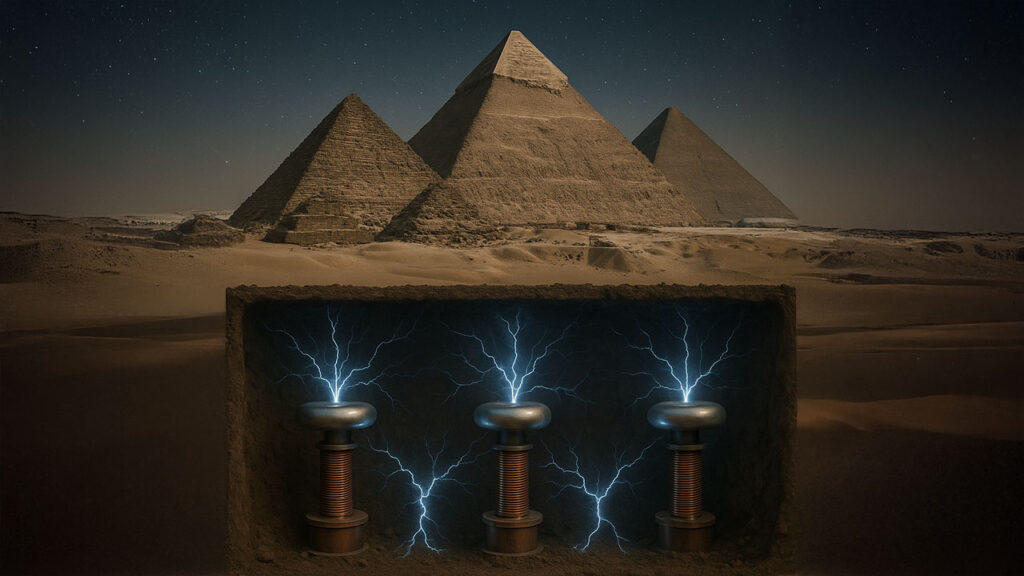
Unearthing the Hidden Depths of Giza: Advanced Technologies
Much of the buzz in the archaeological world these days centers on the research using advanced radar and muon imaging technologies. Recent scans seem to reveal an extensive and intricate underground system beneath the Giza Plateau—extending beneath all three major pyramids.
- In March 2025, a collaborative team from the University of Pisa and the University of Strathclyde reported detecting a sprawling labyrinth of shafts and chambers—some extending nearly 2 km beneath the plateau. These include large vertical shafts, spiral staircases, and pipeline-like channels, possibly connecting the Khufu, Khafre, and Menkaure pyramids.
- Follow-up radar tomography identified a “second hidden city” beneath Menkaure, structurally linked to the Khafre subsurface complexes.
- Synthetic-aperture radar (SAR) scans detected symmetrical voids up to 600 m below and potentially down to 2 000 ft (~610 m), pointing to man-made structures rather than geological anomalies.
- Combined muon tomography surveys—such as ScanPyramids and ScIDEP—continue to illuminate internal pyramid voids, including a 30 m Big Void in Khufu’s pyramid and efforts around Khafre.
- Some proponents suggest these subterranean spaces might have served as conduit systems—perhaps channeling water or energy—though critics label this speculative.
- Italian researchers even propose these structures predate the Dynastic period—by tens of thousands of years—opening the possibility of a “Hall of Records” or other repository of prehistoric knowledge.
- Techniques such as SAR and muon imaging offer non-invasive means of exploring deep beneath the plateau—a leap beyond older ground-penetrating radar that tops out at shallower depths.
- The convergence of physics, archaeology, and geophysics has elevated the discoveries from fringe to more widely considered possibilities.
Skepticism & Criticism:
- Questionable depth accuracy: Some geophysicists argue that current radar tech may not reliably image down to claimed depths (2 km), making sensational claims premature.
- Lack of peer-reviewed consensus: Until detailed mapping, sampling, or excavation confirms the radar findings, mainstream Egyptologists remain cautious.
Context from Previous Discoveries
| Year | Project | Key Finding |
| 2017 | ScanPyramids | Identified a 30 m-long “Big Void” above Khufu’s Grand Gallery using muon spectroscopy. |
| 2023 | ScanPyramids | Discovered horizontal North Face Corridor—explored via an endoscopic probe. |
| 2024 | Egyptian–Japanese radar | Found shallow L-shaped chambers by Giza pyramid base. |
These earlier findings laid the groundwork, demonstrating the potential of non-invasive subsurface exploration.
What Comes Next?
- Rigorous validation: Peer-reviewed publication of the radar and imaging data is crucial for broader scientific endorsement.
- Targeted muon imaging: Teams like ScIDEP (Scintillator Imaging Detector for the Egyptian Pyramids) are deploying detectors around Khafre to verify and detail suspected hidden spaces.
- Limited excavations: Although subject to stringent regulations, small-scale investigations may confirm structural hypotheses.
- Integrated modeling: Archaeologists and engineers will aim to synthesize findings, mapping the architectural, chronological, and functional aspects of the network.
The Stakes & Implications
- Rewriting history? If confirmed, a subterranean city or complex beneath Giza could have profound relevance—potentially predating the well-dated 4th-dynasty pyramids.
- Technological heritage: The presence of pipelines or hydraulic engineering would suggest sophisticated pre-Dynastic capabilities.
- Myth meets science: Fringe concepts like the “Hall of Records” transition from legend to plausible archaeological pursuits—though still unverified.
While mainstream Egyptologists urge caution and call for peer-reviewed publication of the data, a growing number of researchers—independent and academic—are calling for a more open exploration of the Giza Plateau’s underground. Some have proposed using robotic probes or minimally invasive drilling to explore sealed chambers without damaging the surface monuments. Mystics and alternative historians see this as vindication for long-dismissed theories about Giza as more than a necropolis—perhaps a kind of ancient information repository or energy complex.
The Egyptian Supreme Council of Antiquities, under the direction of Dr. Mostafa Waziri, has expressed cautious interest in future excavations. A pilot project is now underway to safely explore a portion of the tunnel network beneath Khafre’s causeway. Preservation remains paramount. Any invasive work will be slow and highly scrutinized, as authorities balance global curiosity with the fragility of the monuments.
Emerging underground maps beneath Giza are among the most provocative archaeological insights of recent years. Yet as promising as radar and muon imaging may be, the true test lies in verifiable data and judicious excavation. Whether these voids prove to be natural karstic formations, tombs, or evidence of ancient subterranean engineering, one thing is clear: Giza’s mysteries have only deepened.
In a groundbreaking move, Egypt has partnered with UNESCO and the Smithsonian Institution to create a virtual platform where 3D models and scans of the tunnels will be accessible to researchers and the public by 2026. This digital archive may spark a new era of archaeological transparency and collaboration—possibly linking mainstream archaeologists with those that take a more intuitive approach.