The Grand Stone Basins of the Sun Temple at Ghurab – Levitation Platforms?
In archaeology things are not always as they seem and become subjects of various theories and interpretations. Scientists are drawn to the most elaborate structures such as the pyramids of Giza. However, many secrets are hidden in the lesser-known sites, such as the Sun Temple at Ghurab. This site is not open to the public and requires special permission for entry and observation.
The Sun Temple is located near Cairo and is surrounded by neighborhoods and agriculture—walled off to protect and preserve it from the general public. So why all the secrecy? What’s hidden behind those walls? Let’s take a look.
Theories abound and it is thought that there may be as much hidden below as there is above. This may be verified when it’s scanned in the same manner that the Giza pyramid is currently being done. It is also speculated that the site is much older than believed and that it pre-dates the dynastic period. During the Egyptian Dynasty period, sites were often excavated, and re-used to build additional temples. This seems to be the case here, where a former energetic site was added on to, to create an expanded sun temple, dedicated appropriately to the Sun God Ra. Which would be fitting since its prior use suggests a solar energy plant among other things. Some of the parts were unaltered, possibly because of fear of disturbing the sacred place.
While mainstream archaeology views the surviving stone fragments—particularly the grand stone basins—as ceremonial or industrial installations, a growing school of alternative researchers argues these structures served a far more sophisticated purpose: functioning as components of an ancient anti-gravity platform, part of a physics-based spiritual technology now lost to history.
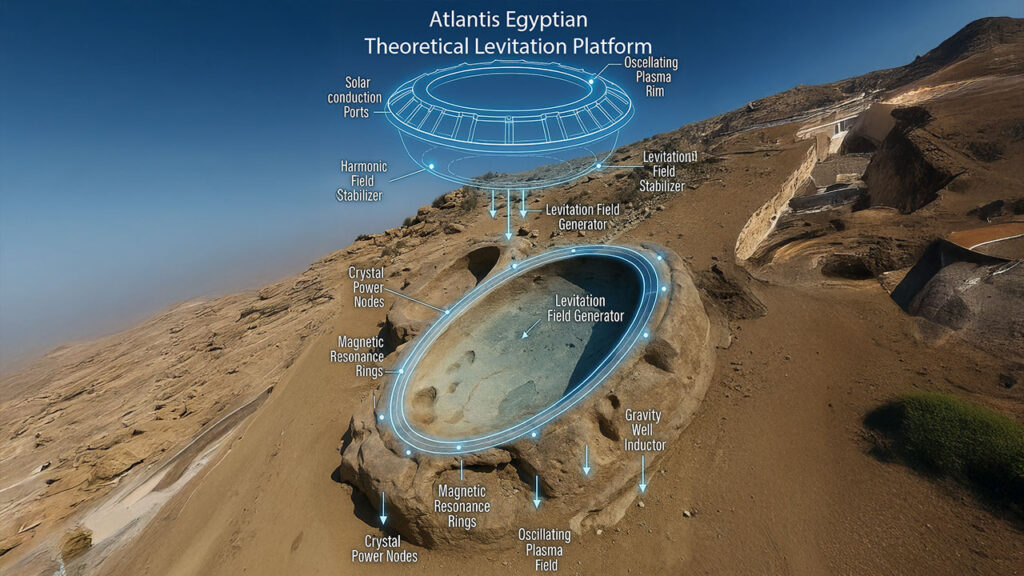
This exploration presents a speculative yet structured interpretation of these stone basins as potential energy devices—possibly levitation field generators utilizing crystal nodes and magnetic resistance rings—designed to manipulate gravity, sound, and resonant fields within the Sun Temple. Considering how much quartz crystal was utilized in the construction of the giant carved basins, this sounds feasible.
1. Context: The Forgotten Solar Complex of Ghurab
The site of Ghurab lies in what was once ancient Egypt’s agricultural heartland. Excavations have uncovered remains of a large palace complex dating to the reigns of Amenhotep III and Akhenaten, as well as vast mudbrick enclosures, fragments of offering platforms, and a handful of peculiar stone artifacts. Among these, the large carved basins—hewn from dense limestone and sometimes quartzite—stand out for their size, precision, and the unknown purpose reflected in their design.
The basins measure several feet across, with symmetrical inner cavities, polished surfaces, and channels that appear strangely engineered rather than merely functional. They resemble neither simple water containers nor industrial vats. Their geometry suggests intentional proportions—ratios familiar to those who study sacred architecture and resonant harmonics.
Alternative theorists argue that these basins formed part of a larger energy array, aligned to the solar cult of the region. To them, Ghurab was not merely a palace precinct—it was an experimental solar-resonant laboratory, blending spiritual rites with an ancient understanding of physics, acoustics, and crystalline energetics.
2. The Basins as Ancient Energy Devices
The hypothesis of an anti-gravity array begins with the material composition of the basins.
2.1 Stone as a Frequency Conductor
Egyptians favored stones with piezoelectric and harmonic resonance properties:
- Quartzite, rich in silica crystals, can store and release subtle electrical charges.
- Limestone contains calcite, known to vibrate and conduct acoustic waves efficiently.
- Granite, used throughout pyramids and temples, contains feldspar and quartz leading to measurable piezoelectric effects.
If the basins were constructed from these materials by design, they could have served as frequency stabilizers, sound resonators, or even charging chambers capable of amplifying or distributing vibrational energies.
2.2 Geometric Symmetry
Each basin’s shape suggests:
- Controlled curvature for containing or directing energy.
- Inner volume ratios similar to cymatic patterns.
- Precision not required for water storage but essential for resonant alignment.
The geometry resembles concave lenses or parabolic dishes—forms used in modern physics to focus waves, whether sound, light, or electromagnetic fields.
This suggests the basins were not static but dynamic components engineered for flow, resonance, and interaction.
3. Anti-Gravity Theories and the Ghurab Basins
Though speculative, the anti-gravity interpretation of Ghurab’s basins emerges from several converging concepts in alternative Egyptology.
3.1 The Principle of Resonant Levitation
Ancient cultures worldwide—Tibetans, Andeans, and Egyptians—are said to have used sound-assisted levitation. Legends describe priests using harmonic chants and tuned instruments to lift monolithic stones.
In the Egyptian context, resonant levitation would require:
- A frequency generator
- A resonant chamber or focusing device
- A material capable of transforming vibration into kinetic force
The basins may have been the anchoring nodes of a larger levitation matrix spread across the Sun Temple.
3.2 Crystal Power Nodes
Within this speculative framework, each basin served as a crystal cradle—a socket or housing where a large quartz crystal (cut, carved, or naturally formed) would be placed.
Quartz, when exposed to sustained vibration or solar energy, generates:
- Piezoelectric charge
- Harmonic amplification
- Coherent standing waves
This would make quartz an ideal component in a levitation field generator.
Some propose that crystals embedded in the basins could have:
- Tuned the vibrational frequency
- Stabilized the field
- Directed the anti-gravity energy upward
3.3 Magnetic Resistance Rings
Circular grooves and channels found around some basins could have housed magnetic resistance rings—metallic or magnetized stone inserts arranged in a toroidal pattern. A rotating or oscillating magnetic ring around a crystal-charged basin could create:
- Counter-rotational fields
- Reduced gravitational effects
- Eddy currents capable of lifting objects
This mirrors modern experiments in maglev technology, where repelling magnetic fields generate lift and stability.
3.4 Levitation Field Generator Hypothesis
By combining:
- Crystal resonance
- Oscillating magnetic rings
- Solar energy absorption
- Harmonic sound waves
the basins could hypothetically produce a localized levitation field.
Objects placed within the field—perhaps stone blocks, sacred artifacts, or ritual elements—might experience a measurable reduction in weight, enabling priests to maneuver or elevate them for ceremonial or engineering purposes.
4. The Sun Temple as an Integrated Energy System
One of the more compelling esoteric interpretations of Ghurab is that the temple complex was designed as a unified energetic architecture.
4.1 Solar Charging
Being a solar temple, the entire facility was oriented toward maximum solar capture.
- Rooftop openings may have funneled sunlight into key chambers.
- Basins could have been exposed to direct sunlight at specific times.
- Heat absorption of quartzite and limestone may have activated their piezoelectric properties.
Daylight would have effectively charged the basins, increasing their capacity to manipulate sonic or magnetic fields.
4.2 Harmonic Pathways
Some researchers propose that:
- The basins were aligned along geometric lines similar to a grid circuit.
- Vibrational pathways connected them through floors or subterranean channels.
- The entire complex may have operated like a resonant circuit, distributing energy through stone, crystal, and acoustic chambers.
This echoes the architecture of Saqqara’s sound healing complex, suggesting a tradition of using structures to manipulate vibrational fields.
4.3 Ceremonial Activation
If the basins were used for anti-gravity rituals or levitation ceremonies:
- Priests might have chanted in specific tones.
- Drums or sistrums could have provided low-frequency vibration.
- Crystals placed in the basins would harmonize with these sounds.
- Magnetic rings would oscillate or rotate to produce counter-fields.
The combination could create a levitational zone where objects—or perhaps even participants—could be elevated.
5. Engineering Mechanics: How the Basins Could Have Worked
Though speculative, let us break down how such a device might theoretically function using principles recognized in physics.
5.1 Step 1: Crystal Resonance Initiation
Large quartz crystals placed within the basin would be:
- Aligned to the Earth’s magnetic field
- Cut or carved at resonant angles
- Activated through sound or heat
When vibrated, these crystals generate coherent fields, acting like stabilizers for larger energy structures.
5.2 Step 2: Magnetic Ring Oscillation
Metal rings or magnetic stones placed in grooves around the basin could:
- Spin
- Oscillate
- Pulse at harmonic intervals
Their movement would create magnetic pressure zones, interacting with the crystal field.
5.3 Step 3: Acoustic Amplification
Priests chanting, clapping, or using instruments could generate:
- Standing waves
- Harmonic overtone fields
- Pressure nodes
The basin’s geometry would amplify specific frequencies, allowing the crystal to convert acoustic energy into electric or vibrational energy.
5.4 Step 4: Anti-Gravity Field Creation
At resonance, the system might produce:
- A coherent torsion field
- Electromagnetic counter-rotation
- A reduction in gravitational pull
This could be similar to:
- Magnetic levitation
- Sonic levitation
- Electromagnetic propulsion
5.5 Step 5: Practical Applications
In this speculative model, the basins could be used to:
- Lift heavy stone weights
- Raise ritual objects
- Demonstrate spiritual power
- Train initiates
- Conduct energy alignment or healing
The Sun Temple would then serve not just as a place of worship but as an energetic research center of its era.
6. Parallels With Other Egyptian Energetic Technologies
The Ghurab basins fit within a broader pattern of anomalous Egyptian artifacts.
6.1 Saqqara’s Sound Chambers
The serpentine-roofed chambers exhibit acoustic resonance capable of inducing physical sensations—evidence Egyptians engineered vibrational spaces intentionally.
6.2 Dendera’s “Lightbulb” Reliefs
Although mainstream scholars dispute it, alternative theorists see:
- Electrical devices
- Plasma coils
- Harmonic emitters
all encoded symbolically in temple artwork.
6.3 The “Heliopolis Benben” Energy Stone
Said to be carved from meteoritic material and capable of generating radiant fields.
6.4 Karnak’s Granite Shrines
Their magnetic alignments and piezoelectric properties mirror the Ghurab basin hypothesis.
7. Could the Basins Actually Levitate Objects? A Scientific Speculation
If these basins ever generated anti-gravity fields, their effect may have been subtle rather than dramatic.
Possible outcomes:
- A 20–30% weight reduction in objects.
- Momentary suspension of small stones or ritual items.
- A hovering effect detectable during specific conditions.
- Enhanced ease of lifting large blocks.
Modern science shows:
- Sound can lift objects at the millimeter scale.
- Magnetic fields can levitate metals, frogs, and droplets.
- Piezoelectric crystals can produce measurable force.
- Resonant chambers can create pressure inversions.
Ghurab could have been an ancient experimental site where multiple energy domains were combined.
8. A Ritualistic Interpretation of Anti-Gravity
Even if the basins were symbolic, they could still represent:
- The lifting of the soul
- The ascent of Ra
- The lightness of being achieved through ritual
- The passage between physical and non-physical realms
Egyptians saw no separation between physics and metaphysics; levitation could be both literal and spiritual.
9. The Basins as Part of a Lost Technology Tradition
If the Ghurab basins were indeed part of a functional levitation platform, they would fit into a global pattern:
- Vimana anti-gravity architecture in India
- Solomon’s Shamir stone-cutting tool
- Peruvian sonic stone lifting
- Tibetan levitation drums
- Atlantean crystal-energy platforms
Some propose Egypt inherited fragments of a pre-diluvian technological tradition—possibly connected to the hypothetical civilizations of Mu or Atlantis, cultures said to have mastered the use of frequency and crystal energy long before the rise of classical empires.
10. Why the Basins Remain Misunderstood
Most Ghurab basins are damaged, displaced, or found without associated components. If they required:
- Crystals
- Magnetic rings
- Copper coils
- Resonant chambers
- Solar activation
then none of these perishable elements survived. This leaves only the stone container, which looks mundane without its energetic context.
Archaeology often interprets surviving fragments as standalone objects, not components of integrated energetic systems.
Whether literal anti-gravity devices or symbolic resonant chambers, the grand stone basins at the Sun Temple of Ghurab whisper of a lost sophistication in ancient Egyptian science. They embody the fusion of physics, spirituality, and cosmology characteristic of Egypt’s most mysterious constructions.
Exploring them through the lens of speculative technology—levitation field generators, crystal power nodes, magnetic resistance rings—allows us to imagine what Egypt might have been if its esoteric traditions preserved not just myth but physics.
In this interpretation, Ghurab becomes more than a ruin: it becomes a laboratory, a resonant node, a place of lifting—both of stone and of consciousness.
Have you ever wondered: How did they lift those huge building blocks? And if they did have a way to levitate solid objects, wouldn’t it be logical to have the site of this energy located nearby? If so, it would throw out the idea that construction crews dragged each stone from some far-off distance. If proven, this could be the answer to illogical speculation.