
Did Ancient Egypt Preserve a Lost Atlantean Science?
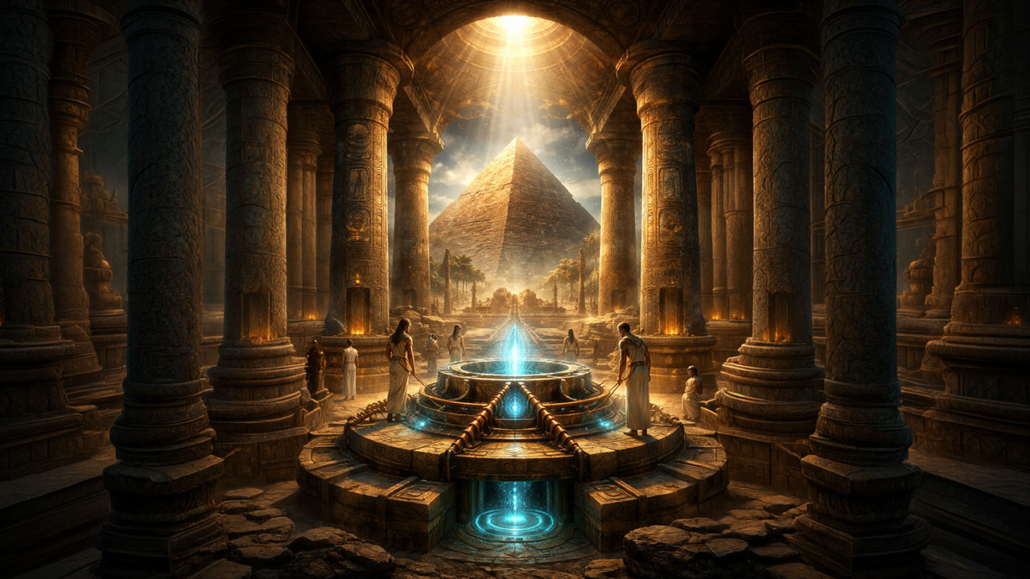 Ancient Egypt has long occupied a strange and enduring place in the human imagination. It is one of the oldest civilizations in recorded history, and yet it rarely feels primitive. Its temples, pyramids, sacred texts, celestial alignments, and monumental stoneworks seem to emerge not as rough beginnings, but as the expression of something already refined. Even now, after centuries of excavation and study, Egypt continues to feel less like a starting point and more like a continuation of something older.
That impression has inspired one of the most enduring alternative theories in sacred history: that Ancient Egypt may have preserved fragments of a lost Atlantean science.
This idea has been approached in many ways over the years—through mythology, esoteric philosophy, psychic readings, sacred geometry, and alternative archaeology. While mainstream history does not accept Atlantis as a historical civilization, the idea itself remains powerful because it speaks to a deeper intuition: that humanity may once have held a more integrated relationship with nature, energy, consciousness, and the built environment than modern history fully accounts for.
If so, Ancient Egypt may not have been Atlantis itself, but one of the places where the memory of such a civilization was carried forward, preserved in stone, ritual, proportion, and sacred design.
Egypt as a Civilization That Feels Older Than Itself
There is something unusual about the way Egypt presents itself to the world. Its civilization appears in the historical record with astonishing coherence: monumental architecture, sophisticated cosmology, complex symbolic systems, funerary sciences, and a priesthood devoted to preserving order between heaven and earth.
This does not mean Egypt appeared overnight, nor does it diminish the long developmental arc that Egyptologists have documented. But even within conventional history, there remains a sense that Ancient Egypt was not merely inventing itself as it went. It often feels as though it inherited and refined a body of knowledge whose roots extended beyond the dynastic age.
That is one of the reasons Egypt continues to exert such a profound pull on those interested in lost civilizations and sacred memory. It gives the impression of being a keeper civilization—a culture that not only built monuments, but intentionally preserved principles.
Its architecture was not merely functional. Its temples were not simply buildings. Its sacred sites appear to have been designed as environments of alignment, transition, initiation, and cosmic correspondence. The more one studies Egypt, the harder it becomes to see it as a civilization concerned only with practical survival. It was also concerned with continuity—between worlds, between ages, and perhaps even between civilizations.
This is where the Atlantean question begins.
Edgar Cayce and the Atlantean-Egyptian Connection
Among the most influential modern voices to connect Egypt and Atlantis was Edgar Cayce, whose readings repeatedly described Ancient Egypt as one of the major destinations of Atlantean survivors after catastrophic earth changes.
In Cayce’s view, Atlantis was not simply a lost island kingdom, but a once-great civilization whose people possessed advanced knowledge in areas that today might be described as spiritual science, energy work, healing, and consciousness. After destruction and upheaval, fragments of that knowledge were said to have been carried into new lands—most notably Egypt.
Whether one interprets Cayce literally, symbolically, or as part of a broader esoteric tradition, his framework remains compelling because it offers a coherent answer to a question many have quietly felt when standing before Egypt’s monuments:
Why does this civilization feel so complete?
In Cayce’s readings, Egypt appears not merely as a birthplace of civilization, but as a repository—a place where an older body of knowledge was intentionally preserved after civilizational collapse. This idea includes the famous concept of the Hall of Records, but the deeper significance lies not in the promise of hidden chambers alone. It lies in the suggestion that Egypt may have served as a bridge between worlds: one that remembered something the rest of humanity gradually forgot.
This does not make Cayce an archaeological source in the conventional sense, nor should he be treated as one. But within the esoteric tradition, his material provides a powerful interpretive lens—one that invites us to look at Egypt not simply as an ancient kingdom, but as a civilization carrying the residue of a much older inheritance.
What If Ancient Technology Looked Nothing Like Modern Technology?
One of the greatest obstacles in discussing “lost ancient science” is that modern people often imagine technology in only one form: machines, wires, circuits, engines, screens, and industrial systems.
But what if ancient technology did not look modern at all?
What if a civilization could encode practical and energetic knowledge not primarily into devices, but into environments?
This possibility changes the entire conversation.
A sacred science, especially one rooted in a different worldview, might not have expressed itself through metal instruments and visible machinery. It might instead have worked through relationships—between geometry and force, sound and space, stone and resonance, orientation and atmosphere, human consciousness and the natural field.
Under this lens, a temple may not simply be a place of worship. It may also be a structured field of interaction.
This broader idea is explored further in Sacred Technology in the Ancient World.
A chamber may not merely hold ritual significance. It may also produce measurable acoustic, thermal, or perceptual effects.
A monument may not simply symbolize cosmic order. It may also participate in it.
This does not require us to claim that ancient Egyptians possessed electricity in the modern industrial sense, nor does it require us to force every sacred site into the category of “power plant.” In fact, those simplifications often obscure the more interesting possibility: that some ancient structures may have embodied a form of integrated science—one in which architecture, cosmology, symbolism, and environmental knowledge were inseparable.
If Atlantis represented an earlier civilization with a more unified understanding of energy, consciousness, and natural law, then the remnants of that science might not survive as obvious machines. They might survive as design principles.
And if so, Egypt would be one of the most likely places to look for them.
Stone, Resonance, and the Language of Sacred Construction
One of the most overlooked aspects of ancient sacred architecture is the role of material itself.
Egypt’s builders worked not only with stone, but with specific stones—granite, limestone, basalt, alabaster—each possessing distinct density, acoustic behavior, and energetic symbolism. While mainstream archaeology understandably focuses on logistics, labor, and construction methods, alternative researchers have long pointed out that the repeated use of certain materials may have had significance beyond durability or beauty.
Stone is not inert in the way modern culture often assumes. It stores heat. It reflects sound. It shapes vibration. It interacts with pressure, atmosphere, and frequency in subtle but real ways. In enclosed or carefully proportioned spaces, those effects can become even more pronounced.
This is one reason so many ancient sites continue to invite speculation about resonance and sacred science. Whether in the chambers of the Great Pyramid, the stone corridors of Saqqara, or the buried complexities associated with Hawara, there is a recurring pattern: architecture that seems to do more than merely occupy space.
It organizes experience.
It focuses movement.
It shapes sensation.
It alters the psychological and acoustic character of the environment.
That alone does not prove “Atlantean technology,” but it does support a more nuanced idea:
Ancient sacred architecture may have functioned as a kind of environmental technology.
And that is a concept worthy of serious contemplation.
Why Giza and Hawara Keep Reopening the Question
Part of the reason the Egypt–Atlantis connection remains alive is that Egypt itself refuses to become fully settled in the public imagination. Even now, the landscape continues to generate new anomalies, discoveries, and interpretive tensions.
At Giza, recent scanning discussions and renewed interest in subsurface structures have reignited public speculation about what may still lie beneath or around the pyramidal complex. Some modern interpreters have gone much further, suggesting deep columns, cylindrical formations, or even coil-like structural elements beneath the plateau. Such claims remain highly contested and should not be treated as established fact. Yet their popularity reveals something important: the question of whether Egypt’s monuments served deeper functions has not gone away.
Similarly, the Lost Labyrinth of Hawara, described in antiquity as one of the greatest structures in Egypt, continues to attract attention because of modern subsurface imaging and reports of buried architectural complexity. Even if exaggerated claims are set aside, Hawara still raises a profound possibility—that some of Egypt’s most extraordinary spaces remain hidden, collapsed, submerged, or only partially understood.
These modern anomalies do not “prove Atlantis,” nor do they automatically validate energy theories. But they do serve as reminders that Ancient Egypt may still conceal layers of purpose and design that have not been fully recovered.
And perhaps that is the deeper point.
The mystery is not only in what is hidden underground. The mystery is in how much may still be hidden in plain sight—in the proportions, placements, materials, and spatial logic of the structures themselves.
Tesla, Earth Forces, and the Ancient Technology Question
Whenever the idea of “lost science” enters the discussion, comparisons to Nikola Tesla often follow. This is understandable, though it should also be handled with care.
Tesla’s work touched on resonance, frequency, earth conductivity, atmospheric electricity, wireless transmission, and the possibility that energy could be approached not merely as fuel, but as a field. For many alternative researchers, this has made him a kind of modern bridge figure—someone whose theories help provide language for reexamining ancient structures.
The comparison becomes especially intriguing when one considers that ancient sacred builders may have been deeply attentive to:
- location
- geological placement
- orientation
- material behavior
- and the interaction between built form and the natural environment
Again, this does not mean the pyramids were simply “Tesla machines” built in antiquity. That claim is too blunt and too modern in its assumptions. But Tesla does offer something valuable: a conceptual reminder that technology can be field-based, resonant, and environmental, not only mechanical.
Seen this way, Egypt begins to look less like a civilization of isolated monuments and more like a culture that may have understood how to build in relationship with the earth itself.
And if such principles once existed in a more complete form, it is not difficult to see why some would interpret them as remnants of a lost Atlantean science.
Atlantis as Memory, Not Just Myth
Perhaps the most useful way to approach Atlantis is not to ask only whether it was a literal place, but to ask what it may represent in the deeper human imagination.
Atlantis may symbolize the memory of a world in which science, spirituality, architecture, healing, and cosmic order were not separate disciplines. It may represent a civilization that understood reality in a more unified way—one that saw no divide between the sacred and the structural, between consciousness and environment, between temple and technology.
If so, then the legacy of Atlantis would not necessarily survive only as submerged ruins or dramatic artifacts. It might survive in patterns:
- in sacred geometry
- in temple alignment
- in initiatory systems
- in acoustic architecture
- in cosmological symbolism
- and in civilizations that seem to remember more than they should
This is why Egypt remains such a compelling candidate in the Atlantis tradition. It does not merely preserve old stones. It preserves a way of thinking.
Its architecture suggests order.
Its myths suggest continuity.
Its sacred spaces suggest function beyond ornament.
And its enduring mysteries suggest that not all of its purposes have been fully understood.
A Civilization of Preserved Memory
So, did Ancient Egypt preserve a lost Atlantean science?
The honest answer is that no conventional archaeological framework can currently prove such a claim in a literal or final sense. But that does not mean the question lacks value. On the contrary, it may be one of the most fruitful questions we can ask—because it invites us to look at Egypt not merely as an ancient civilization, but as a civilization of preserved memory.
If Atlantis existed as a real place, a symbolic memory, or a forgotten mode of human understanding, then Egypt may have been one of the places where that inheritance endured most clearly.
Not necessarily in obvious machines.
Not necessarily in dramatic hidden artifacts.
But in something more subtle and perhaps more profound:
in the design of sacred space, the permanence of stone, the continuity of symbolic language, and the possibility that ancient science once moved through architecture itself.
If Atlantis survives anywhere, perhaps it survives not only beneath the sea, but in the sacred memory carried forward through civilizations that remembered enough to build for eternity.