
Sacred Technology in the Ancient World
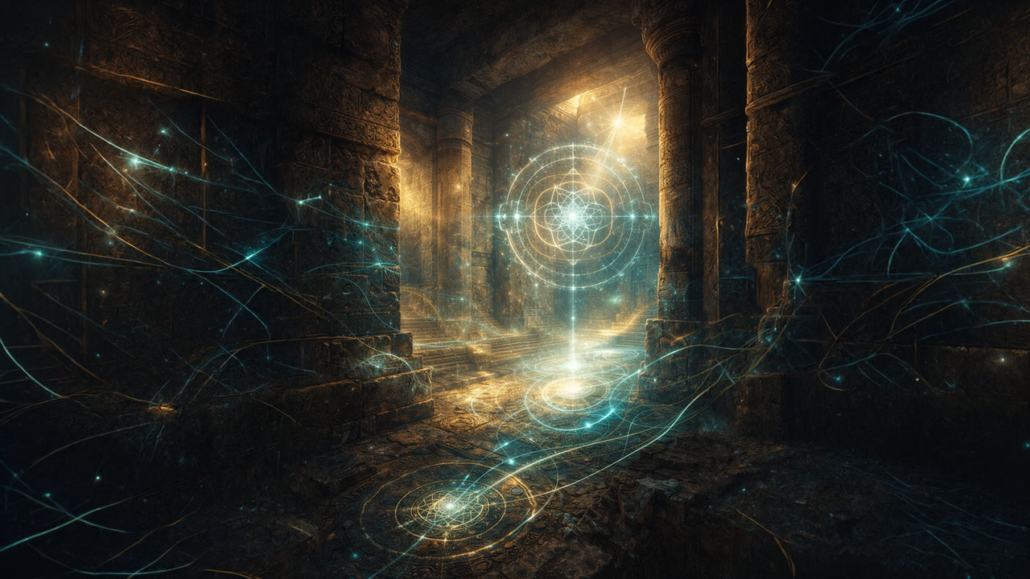
Modern people are taught to recognize technology in only a narrow and familiar form. We tend to imagine wires, circuits, engines, screens, metal housings, and visible machines. We think of technology as something manufactured, external, and mechanical—something that can be switched on, measured, upgraded, and eventually discarded.
But what if the ancient world understood technology in a very different way?
What if some of the most extraordinary structures of the ancient world were not merely ceremonial, symbolic, or decorative, but were built according to principles that blended architecture, environment, geometry, sound, and human consciousness into a single integrated system?
This possibility opens an entirely different way of looking at the past.
Across the ancient world, one finds a recurring pattern: sacred sites placed with uncanny intention, monumental stoneworks aligned to celestial events, chambers whose acoustics behave in unusual ways, and structures that seem designed not only to stand in the landscape, but to interact with it. Whether in Egypt, the megalithic world, South America, India, or the Pacific, these places continue to evoke the same quiet question:
Were the ancients building temples alone—or were they also building technologies of another kind?
To explore this idea seriously, we must first loosen our modern definitions. If sacred technology existed in the ancient world, it likely did not resemble our own industrial tools. It may have been less about machines and more about relationships—between stone and vibration, geometry and force, sky and earth, movement and perception, structure and field.
Seen this way, the ancient world begins to look not less advanced, but differently advanced.
A Different Definition of Technology
One of the greatest barriers to understanding the ancient world is the assumption that technological sophistication must always leave behind the same kinds of evidence that modern technology does. We look for obvious devices, obvious mechanisms, and obvious infrastructure. When we do not find them, we often conclude that a civilization must have been limited to religion, superstition, and symbolic expression.
But that assumption may be far too simplistic.
Technology, at its root, is not simply machinery. It is the practical application of knowledge to shape outcomes.
By that definition, a civilization could be profoundly technological without building in a modern industrial style. Its technologies might instead be embedded in:
- architecture
- proportion
- acoustics
- site placement
- atmospheric interaction
- material properties
- ritualized movement through space
In such a world, the building itself may have been the instrument.
This is an uncomfortable idea for the modern mind because it blurs categories we prefer to keep separate. We tend to divide science from spirituality, engineering from ritual, and symbolic meaning from measurable function. Ancient civilizations may not have made those distinctions in the same way.
A temple, for example, may have served many roles at once. It may have been a place of worship, yes—but also a chamber of initiation, a container of cosmic proportion, an acoustic environment, a calendar in stone, and a structure designed to align human awareness with larger natural patterns.
In this sense, sacred technology would not be a contradiction. It would be an older and perhaps more complete expression of knowledge.
The Ancient World Was Built With Intention
One of the most striking features of ancient sacred architecture is the degree to which it appears intentional at every level.
The placement of many ancient sites is not random. They are often positioned in relation to mountains, fault lines, rivers, stars, solstices, cardinal directions, or unusual geological features. Their builders seem to have understood that location matters—not only practically, but energetically and symbolically.
The same is true of orientation. Across cultures, sacred sites are frequently aligned to celestial events or directional principles in ways that suggest careful observation and deliberate planning. This is not accidental construction. It is a form of applied knowledge.
Then there is the matter of stone itself.
The ancient world did not simply build with what was available. Again and again, it selected specific materials and moved them across astonishing distances. Granite, basalt, limestone, and other dense stones appear in sacred settings where their use often seems to exceed mere convenience. Modern explanations understandably focus on engineering and labor, but the repetition of material choice invites deeper reflection.
Why these stones? Why these forms? Why these placements?
At the very least, the ancients appear to have understood that matter behaves differently under different conditions—and that built environments can be shaped to produce more than shelter.
This is one of the reasons ancient sacred sites continue to resist reduction. They often feel like layered constructions, operating on multiple levels at once. They are symbolic, yes. But they are also spatially intelligent. They guide movement. They direct attention. They create thresholds. They intensify stillness. They alter the sensory experience of those who enter them.
That is not accidental.
It suggests that the ancient world may have possessed a deeper understanding of how space itself can be used as a tool.
Stone, Sound, and the Hidden Language of Resonance
If there is one aspect of sacred technology that modern culture has only begun to reconsider, it is the role of sound and resonance.
Stone is often treated as static and inert, but in reality it is highly responsive to environmental conditions. It reflects sound. It stores heat. It shapes pressure. It interacts with vibration in ways that become especially noticeable in enclosed chambers, passageways, domes, and carved interior spaces.
Ancient builders may not have spoken about acoustics in modern scientific language, but they almost certainly experienced the effects of sound in stone spaces. A voice behaves differently in a granite chamber than in an open field. A tone changes when it is held inside a vaulted corridor. Repetition, echo, harmonic reinforcement, and standing wave effects can all alter how a space is perceived and how the body responds within it.
This becomes especially intriguing when one considers how often sacred architecture includes:
- enclosed chambers
- narrow corridors
- resonant cavities
- subterranean spaces
- domed or vaulted forms
- repeated stone symmetry
These are not merely aesthetic choices. They shape the behavior of sound and the felt experience of presence.
This does not mean every temple was an “acoustic machine” in a simplistic sense, nor does it require dramatic claims about lost energy devices. But it does point toward a more refined possibility: that some sacred sites were designed to modulate human experience through controlled environmental conditions.
That modulation may have involved sound. It may also have involved silence, reverberation, vibration, pressure, light, shadow, temperature, and spatial compression.
In other words, the ancient world may have understood that architecture can do more than house activity.
It can influence consciousness.
And if that principle was known and intentionally applied, then resonance itself may have been part of an older sacred science.
Geometry as Applied Knowledge
Few aspects of the ancient world have inspired more wonder than its use of geometry.
From pyramids and temples to megalithic circles, stepped platforms, and carefully proportioned sanctuaries, one finds recurring evidence that ancient builders were deeply concerned with form, ratio, symmetry, and alignment. Geometry was not merely decorative. It appears to have been a governing language.
Modern people often interpret sacred geometry symbolically, and rightly so. But it may also have functioned practically.
Geometry organizes space. It directs flow. It influences how a person moves, looks, pauses, and perceives. Certain ratios create balance. Certain forms intensify focus. Certain alignments establish relationship between the structure and the wider world.
When geometry is applied at scale, it becomes more than pattern. It becomes environmental instruction.
This is where the idea of sacred technology becomes especially compelling. If a civilization understood geometry not only as abstract mathematics but as a living principle—one that links structure, cosmos, and human perception—then geometry itself may have been one of its most advanced tools.
A temple built with precise proportion may have been doing more than honoring divine order. It may also have been participating in it.
A pyramid may have represented ascent and orientation symbolically, while also embodying geometric relationships that affect stress distribution, interior acoustics, thermal behavior, or spatial perception.
Again, this does not require us to overstate what we know. It simply asks us to take ancient design more seriously than modern reductionism often allows.
The ancients may have understood that geometry is not just something seen.
It is something felt.
Sacred Sites as Living Interfaces
One of the most useful ways to rethink ancient sacred architecture is to imagine it not as a static monument, but as an interface.
An interface connects two things. It allows exchange. It creates relationship.
Seen through this lens, a sacred site may have been designed as an interface between:
- earth and sky
- body and environment
- sound and silence
- matter and meaning
- human consciousness and cosmic order
This helps explain why so many ancient structures feel difficult to categorize using modern terms. They are not only tombs, not only temples, not only observatories, not only ritual spaces. They may have functioned across several of these categories at once.
This integrated quality is one of the strongest signs that the ancient world may have possessed a different technological model altogether.
Rather than isolating one function per structure, sacred builders may have created spaces capable of working on multiple levels simultaneously. A single site could orient the body, structure ritual movement, mark astronomical cycles, shape acoustics, encode symbolic teachings, and alter the felt experience of those who entered it.
That is not primitive design.
That is sophisticated systems thinking expressed through stone.
And perhaps this is why so many ancient sites continue to feel alive long after their original cultures have faded. They still seem to do something, even when we no longer fully understand what that something was.
A Forgotten Relationship With the World
Perhaps the deepest implication of sacred technology is not that the ancients possessed secret machines, but that they may have inhabited a fundamentally different relationship with the world itself.
Modern civilization often approaches reality in fragmented terms. We divide science from spirituality, engineering from symbolism, function from beauty, matter from meaning. Ancient sacred cultures may have worked from a more unified understanding—one in which the physical and the metaphysical were not separate realms, but interwoven dimensions of the same living order.
If that is true, then what we call “sacred technology” may represent not merely lost knowledge, but a lost orientation of mind.
It may point to a time when human beings understood that architecture could be ceremonial and functional, symbolic and measurable, spiritual and practical all at once.
This possibility matters today because it suggests that the ancient world may still have something to teach us—not only about the past, but about the limits of our own assumptions.
This possibility becomes especially compelling in Ancient Egypt, where sacred architecture has long inspired deeper questions about whether an older science may have survived in symbolic and structural form.
Perhaps we have inherited the shells of great sacred sites while forgetting the deeper intelligence that once animated them.
Perhaps we have preserved the stones, but not the science.
And perhaps the question is no longer whether the ancient world was advanced, but whether we have been using too narrow a definition of advancement all along.
The Echo of a Lost Science
Sacred technology in the ancient world may never be fully reconstructed in modern terms. Some of its principles may remain hidden in collapsed chambers, forgotten traditions, vanished priesthoods, or forms of perception that modern culture no longer trains.
But the pattern remains.
Again and again, the ancient world leaves behind structures that seem to exceed ordinary explanation—not because they are impossible, but because they suggest a civilization working from a more integrated and perhaps more subtle understanding of reality.
That understanding may have expressed itself through stone, geometry, resonance, celestial alignment, and the deliberate shaping of space.
If so, then sacred technology was not fantasy.
It was a way of building in conscious relationship with the forces of life.
And if fragments of that science still endure, they may survive not only in the ruins of the ancient world, but in the enduring intuition that some places were built to do more than stand.
They were built to remember.