
Patrick Flanagan and Nikola Tesla: The Mystery of Reincarnation, Lost Inventions, and Remembered Knowledge
An exploration of an extraordinary inventor, his claim of a previous lifetime as Nikola Tesla, and the enduring question of whether knowledge can survive physical death.
A Book From 1973—and a Mystery That Never Quite Disappeared
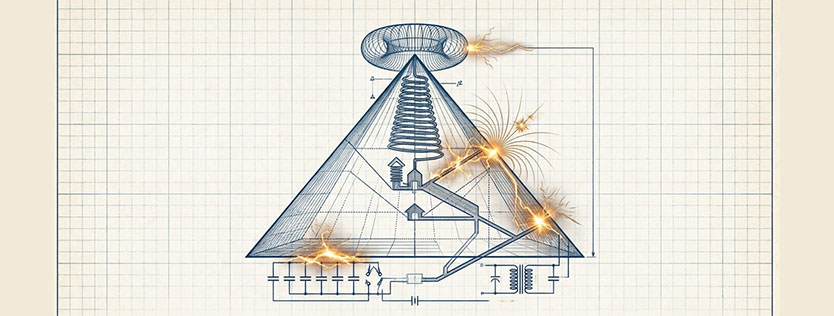
In 1973, Pyramid Power by G. Patrick Flanagan appeared at a time when growing numbers of readers were exploring subjects that existed beyond the boundaries of conventional science. Ancient civilizations, the mysteries of the Great Pyramid, unexplained energies, and the nature of human consciousness were becoming part of a wider cultural conversation.
For those who encountered the book during that period, Flanagan represented an unusual combination of technical ingenuity and unconventional thinking. He was interested not simply in the symbolism of pyramids, but in whether their physical geometry might produce measurable effects.
More than fifty years later, revisiting Flanagan’s work raises questions that extend well beyond pyramid research.
One of the most intriguing emerges from an interview with Regina Meredith on Gaia’s Open Minds. During their conversation, Flanagan made an extraordinary assertion: he believed that he had lived previously as Nikola Tesla, the pioneering electrical inventor whose discoveries helped shape the modern technological world.
Flanagan did not present this belief merely as a spiritual impression or an unexplained affinity for Tesla. He claimed to remember technical knowledge from that earlier lifetime—knowledge he said enabled him to construct sophisticated electrical equipment while still a child.
He also described an encounter with a man who allegedly had access to Tesla’s papers following the inventor’s death in 1943. According to Flanagan, that encounter became an unexpected test of his memories.
Was Flanagan describing a genuine case of reincarnation? Could his experiences have involved an unusual form of intuition or subconscious learning? Or do they belong to the broader history of extraordinary claims made by unusually gifted inventors?
The available evidence does not settle those questions. But his story offers a fascinating opportunity to examine the relationship between creativity, memory, invention, and consciousness.
The Eight-Year-Old Who Built a Tesla Coil
Flanagan’s account begins in early childhood.
Speaking with Meredith, he recalled lying in his crib and experiencing the unusual sensation that he had returned to physical life. He described looking at his feet and realizing that he would have to grow up before resuming whatever work he believed he had left unfinished.
As he grew older, his interest in mechanical devices and electricity became increasingly pronounced.
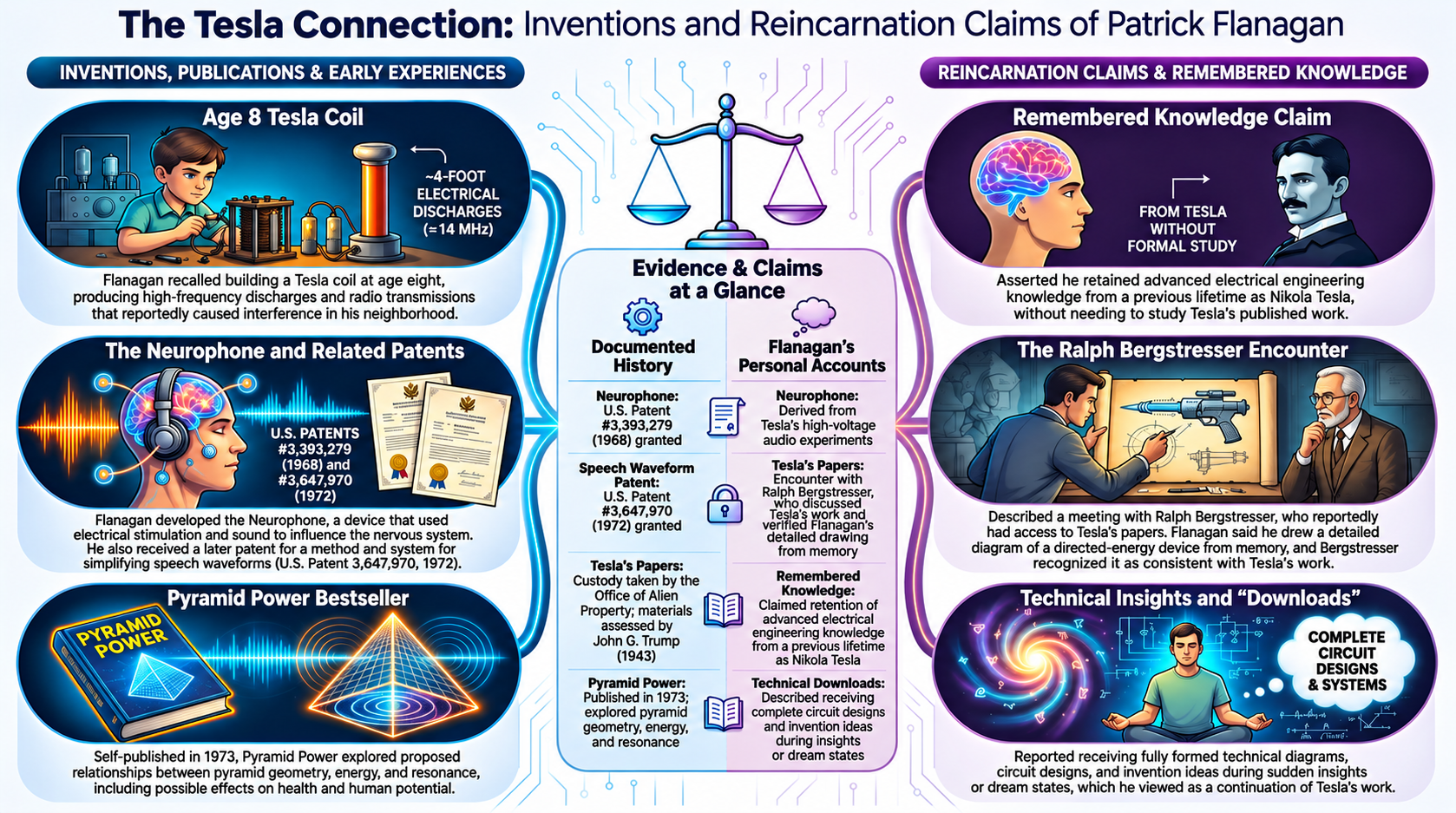
He remembered dismantling a ship’s compass when he was approximately three years old. By seven, he said, he was already experimenting with electrical equipment. At eight, he claimed to have obtained a general-class amateur radio license and to have designed and constructed his own radio apparatus using salvaged components.
The most remarkable claim concerned a Tesla coil.
A Tesla coil is a resonant electrical transformer circuit capable of generating very high voltages and producing dramatic electrical discharges. Nikola Tesla developed the technology during his investigations into high-frequency alternating currents and wireless electrical phenomena.
Flanagan told Meredith that he built his first Tesla coil at eight years old.
He described operating it at approximately 14 megahertz and producing electrical discharges that extended about four feet.
Such a device would have been a considerable undertaking for a child, particularly during the era before modern electronics kits, inexpensive digital instruments, and online instructional resources.
According to Flanagan, his experiments also caused considerable disruption in his neighborhood.
He described radio transmissions reaching people in other countries and claimed that the electrical interference from his apparatus affected nearby equipment. In one especially colorful recollection, he said a neighbor received a spark from a water faucet.
Eventually, he recalled, complaints forced him to stop operating the apparatus in that manner.
These accounts are striking, but they are still autobiographical testimony. Without contemporaneous photographs, equipment records, amateur radio licensing documents, or independent witnesses, the precise specifications and circumstances cannot be established from the interview alone.
Yet the importance of the story lies in something beyond the technical achievement itself.
Flanagan maintained that he had not learned everything through ordinary study.
He believed he already possessed the knowledge.
The Claim of Remembered Knowledge
When Meredith asked whether he had consulted Tesla’s published diagrams or simply remembered how the technology worked, Flanagan answered:
“I didn’t have to go back and research. I remembered all of it.”
That statement transforms an account of childhood genius into something considerably more mysterious.
Many inventors have demonstrated extraordinary ability at unusually young ages. Some possess exceptional visual memory, mathematical intuition, or the capacity to understand mechanical relationships with very little formal instruction.
Such abilities, while uncommon, do not necessarily require supernatural explanations.
Flanagan, however, interpreted his experiences differently.
He believed his knowledge was connected to a previous existence as Nikola Tesla.
Tesla died in New York City on January 7, 1943. Flanagan was born in 1944, a chronological proximity that became significant within his understanding of reincarnation.
The timing alone cannot demonstrate that one individual was reborn as another. Nevertheless, for someone who believes in reincarnation, the relationship between the two lifetimes naturally invites further consideration.
What makes Flanagan’s claim especially unusual is its emphasis on practical technical knowledge.
Reports of past-life memories often concern places, relationships, personal identities, or emotionally significant events. Flanagan described something different: an apparent continuity of engineering ability.
If his interpretation were correct, reincarnation would involve more than the survival of personality or emotional memory. It might also involve the preservation of acquired skills and specialized understanding.
That possibility leads to a difficult question.
What, exactly, would have to survive death for a person to retain the ability to design an electrical circuit?
Would the knowledge exist as explicit memories, comparable to remembering a book? Would it persist as an intuitive understanding of relationships and principles? Or might the apparent continuity arise from mechanisms not yet adequately understood?
These questions cannot be answered simply by accepting or rejecting Flanagan’s account.
They require a closer examination of the evidence.
Nikola Tesla: An Inventor Surrounded by Mystery
Nikola Tesla occupies an unusual place in the history of technology.
His contributions to alternating-current electrical systems, electric motors, high-voltage experiments, and wireless technologies were substantial. His imagination also carried him toward ambitious proposals that were never fully realized.
Tesla became particularly interested in transmitting energy without conventional wires. His experiments with resonant electrical systems led to increasingly ambitious demonstrations and eventually to the construction of the Wardenclyffe Tower on Long Island.
Although the tower never fulfilled Tesla’s vision of a global wireless system, it remains one of the most recognizable symbols of his experimental ambitions.
Tesla was also known for his ability to visualize inventions mentally.
In autobiographical accounts, he described imagining mechanisms in great detail before constructing physical prototypes. He sometimes portrayed the process of invention as one in which complete systems appeared in his mind.
This aspect of Tesla’s creative process has encouraged later comparisons with intuition, altered states of consciousness, and the possibility of knowledge emerging from sources beyond deliberate reasoning.
There is an important distinction, however, between an inventor describing powerful mental visualization and evidence that knowledge originates outside the brain.
Tesla’s accounts demonstrate how he understood his own creative experience. They do not independently establish a nonphysical source of information.
Flanagan nevertheless believed he recognized something familiar in Tesla’s abilities.
In the Meredith interview, he spoke of receiving technical information in ways that seemed to bypass ordinary step-by-step problem-solving.
For him, the similarity was not merely intellectual.
It was personal.
The Encounter With Ralph Bergstresser
Perhaps the most intriguing episode in Flanagan’s account concerns a man named Ralph Bergstresser.
Flanagan said the encounter occurred after the publication of Pyramid Power in January 1973.
According to his recollection, Bergstresser hosted gatherings at his home where speakers discussed unusual scientific and philosophical subjects. Flanagan attended some of these meetings to speak about his pyramid research.
During a conversation about Nikola Tesla, Flanagan told Bergstresser that he believed he had been Tesla in a previous lifetime.
Bergstresser reportedly responded with an unexpected challenge.
He claimed to have been among the first people who entered Tesla’s hotel room after the inventor’s death and to have participated in removing papers from a safe.
If Flanagan truly remembered Tesla’s life, Bergstresser allegedly suggested, he should know something about the contents of those papers.
The challenge focused on a projected-energy weapon that Tesla had reportedly developed.
Flanagan said he drew a technical diagram from memory.
According to his account, Bergstresser recognized the design and accepted it as confirmation that Flanagan had been Tesla.
It is a remarkable story.
It is also one for which several essential pieces of evidence remain unavailable.
We do not have the drawing Flanagan says he produced. We do not have an independently authenticated copy of the drawing allegedly used for comparison. Nor have we established, from the historical records examined for this article, that Bergstresser participated in the recovery of Tesla’s possessions.
Consequently, the episode must be treated as Flanagan’s account of an encounter rather than as independently verified proof of reincarnation.
That distinction does not make the story unworthy of investigation.
On the contrary, it identifies exactly where further historical research could be valuable.
What Actually Happened to Tesla’s Papers?
The circumstances surrounding Tesla’s possessions after his death are among the better-documented elements of this mystery.
Tesla died at the New Yorker Hotel in January 1943, during World War II.
Government authorities were concerned that his technical materials might contain information of military significance. Tesla had publicly discussed concepts involving concentrated beams of energy and defensive weapons, making his unpublished papers a matter of potential national-security interest.
The United States Office of Alien Property took custody of his possessions.
Federal records confirm that officials subsequently examined his technical papers, which had been transferred to storage in Manhattan.
One of the specialists involved was John G. Trump, an electrical engineer associated with the Massachusetts Institute of Technology and wartime scientific research.
In a January 30, 1943 assessment, Trump concluded that the material he examined did not contain previously undisclosed, workable principles or apparatus that would offer the military the extraordinary advantages some had anticipated.
His assessment did not mean that Tesla had accomplished nothing of importance. Tesla’s established contributions to electrical engineering were already substantial.
Rather, Trump was evaluating the specific papers and equipment available to him following Tesla’s death.
The historical record also makes an important distinction concerning the FBI.
Although FBI files contain correspondence and reports about Tesla, the bureau later stated that his papers had been held by the Office of Alien Property, not by the FBI itself.
These records establish that Tesla’s papers were examined under government authority.
They do not establish every detail of Flanagan’s account.
In particular, they do not verify that Bergstresser personally retrieved the papers or possessed a particular diagram of Tesla’s proposed weapon.
The distinction matters because the documented history of Tesla’s possessions is fascinating in its own right. It does not require embellishment to become an extraordinary chapter in the history of twentieth-century invention.
The Emotional Dimension of Flanagan’s Claim
There is another aspect of the Meredith interview that deserves attention.
When the conversation turned to Tesla’s final years, Flanagan became visibly emotional.
He described feelings of mistreatment and disappointment that he associated with his alleged previous lifetime.
Meredith acknowledged his reaction and suggested that the subject remained painful.
For viewers, the moment may be among the interview’s most memorable passages.
Flanagan did not speak about Tesla merely as a historical figure he admired. He appeared to identify deeply with Tesla’s experiences and with the hardships he believed the inventor had endured.
Emotional conviction, however, cannot establish the historical accuracy of a claimed past-life memory.
People can experience powerful emotions in connection with spiritual beliefs, dreams, imagined events, historical figures, or deeply held personal interpretations.
The emotional intensity of an experience is real to the person having it, even when its underlying explanation remains uncertain.
Flanagan’s reaction therefore tells us something important about the sincerity and personal significance of his belief.
It does not, by itself, determine whether that belief was literally true.
The Neurophone: An Invention With a Documented History
Flanagan’s life cannot be understood solely through his reincarnation claims.
He also pursued a series of inventions, including a device known as the Neurophone.
In the Meredith interview, Flanagan said he began developing the Neurophone at approximately thirteen years old.
He described it as an electronic system intended to communicate audio information through electrical stimulation rather than through ordinary sound delivered to the ears.
Flanagan associated the idea with experiences he believed he remembered from Tesla’s lifetime.
According to his account, he had observed unusual auditory sensations during high-voltage electrical experiments and later attempted to reproduce related effects using a purpose-built electronic device.
The Neurophone is particularly interesting because it has a verifiable patent history.
U.S. Patent No. 3,393,279 was granted on July 16, 1968. A subsequent Neurophone-related patent, No. 3,647,970, was granted in 1972.
These patents establish that Flanagan developed and formally described electronic inventions.
They do not, however, independently establish all the physiological effects he attributed to the devices.
In the interview, Flanagan recounted an emotional demonstration at the U.S. Patent Office.
He claimed that a deaf employee was able to perceive music through his apparatus and that the experience moved those present to tears.
It is an affecting story, but the particular demonstration requires independent documentation before it can be presented as established fact.
There is also a scientific distinction between obtaining a patent and proving every claimed application of a technology.
Patents concern inventions and their descriptions. They are not equivalent to independent clinical trials, medical approval, or broad scientific acceptance.
The Neurophone remains historically significant as an example of Flanagan’s unconventional electronic experimentation.
Its existence also illustrates why his story attracted attention: he was not simply discussing unusual theories. He had built devices and pursued patents.
Where Do Inventions Come From?
During the interview, Meredith asked Flanagan about the way new inventions came to him.
His response introduced another dimension of the mystery.
Flanagan described struggling with technical problems for days or weeks, sometimes without making progress.
Then, he said, a solution would arrive suddenly.
He called these experiences downloads.
According to his account, the information could include circuit diagrams, component relationships, and an apparently complete understanding of how to construct a device.
He said such experiences occurred during waking consciousness, transitional states, or dreams.
For Flanagan, the experience seemed different from ordinary intellectual work.
He felt that assistance came from somewhere beyond his conscious reasoning.
This description has parallels in the history of creativity.
Scientists, mathematicians, writers, and inventors have frequently reported that solutions emerged unexpectedly after periods of concentrated effort.
The phenomenon is sometimes described as incubation: the mind continues processing a problem outside deliberate conscious attention, and an insight becomes available later.
Sleep and periods of reduced concentration may contribute to this process.
Such explanations offer plausible mechanisms for sudden insight, although they do not necessarily account for every subjective feature of an individual’s experience.
Flanagan rejected the suggestion that his brain was merely processing information subconsciously.
He believed something more profound was occurring.
This difference between the experience itself and its interpretation is central to the mystery.
A sudden insight may be genuine, useful, and technically sophisticated without revealing where the information ultimately originated.
Whether Flanagan’s experiences involved subconscious problem-solving, exceptional intuition, spiritual inspiration, or something else remains an open question.
Pyramid Power and the Search for Ancient Knowledge
For many readers, Patrick Flanagan will always be associated with Pyramid Power.
The book was published in 1973 and became part of the expanding literature on alternative science, ancient mysteries, and consciousness.
Flanagan told Meredith that his investigations began partly through an interest in Wilhelm Reich’s theories of orgone energy.
Reich proposed the existence of a universal life-energy field, although his concept of orgone energy has not been scientifically established.
Flanagan became interested in whether geometrical structures, particularly pyramids, might influence physical or biological processes.
He experimented with pyramid-shaped constructions and developed theories concerning geometry, energy, and resonance.
In the interview, he recalled being unable to find a publisher for his manuscript. He said he borrowed money to publish the book himself and that it eventually sold approximately 1.5 million copies.
The 1973 publication is independently documented. The precise sales figure, as given in the interview, has not been independently verified here.
The book’s appeal was closely connected to a larger cultural fascination with the Great Pyramid of Giza.
For generations, the monument had inspired speculation about mathematical relationships, astronomical alignments, hidden chambers, and the possible survival of knowledge from earlier civilizations.
Some of those investigations led to legitimate archaeological and architectural discoveries.
Others produced interpretations that extended well beyond the available evidence.
Flanagan’s work belongs to this wider history of attempts to understand whether ancient structures might embody principles that modern investigators had overlooked.
Geometry, Resonance, and the Great Pyramid
One of the more interesting aspects of Flanagan’s pyramid research was his attention to resonance.
Resonance is a genuine physical phenomenon.
A system can respond strongly to particular frequencies depending on its structure, dimensions, materials, and surrounding conditions.
Musical instruments provide familiar examples. The shape and dimensions of an instrument help determine how it vibrates and which frequencies it reinforces.
Rooms and architectural spaces also exhibit resonant characteristics.
Flanagan suggested that geometrical relationships within structures could produce significant effects.
In his conversation with Meredith, he described how the length, width, and height of an enclosed space can relate to different resonant frequencies.
That basic principle has a foundation in acoustics.
However, moving from ordinary acoustic resonance to claims about special pyramid energies, biological rejuvenation, or unusual consciousness effects requires additional evidence.
A structure having measurable resonant properties does not automatically demonstrate that it possesses a unique or beneficial energy field.
This distinction is especially important when considering the Great Pyramid.
Its geometry, internal passages, chambers, and construction methods are worthy of serious study.
Researchers can investigate acoustics, material properties, architectural proportions, and environmental conditions without presuming that the monument was designed as an advanced energy machine.
At the same time, the question of why ancient builders selected particular proportions and configurations remains a legitimate historical subject.
The challenge is to distinguish what can be measured from what has been proposed.
For readers interested in Mu and other traditions of lost civilizations, that approach creates room for exploration without turning speculation into established history.
Ancient Civilizations and the Possibility of Forgotten Knowledge
The idea that earlier civilizations possessed knowledge subsequently forgotten is not inherently unreasonable.
Human history contains many examples of technologies, construction methods, languages, and cultural practices that disappeared or became difficult for later generations to understand.
Knowledge can be lost when societies collapse, trade networks break down, written records disappear, or specialized traditions cease to be transmitted.
Archaeology has repeatedly demonstrated that ancient peoples possessed sophisticated practical knowledge.
Their accomplishments in navigation, agriculture, engineering, astronomy, and monumental construction often required careful observation and accumulated experience across generations.
But recognizing ancient sophistication is different from assuming the existence of an undocumented global civilization equipped with technologies comparable to modern electrical engineering.
The proposed civilizations of Mu and Lemuria occupy a different evidentiary category from historically documented cultures.
Their stories are important within the history of alternative interpretations, esoteric traditions, and speculation about humanity’s remote past. They are not currently established as lost continents or technologically advanced civilizations by mainstream geological and archaeological evidence.
Flanagan’s theories nevertheless intersect with a question that has long fascinated readers of Mu the Motherland:
Could some ancient monuments preserve forms of knowledge that have not yet been fully understood?
That question can be explored through careful research into architecture, archaeology, traditional knowledge, and the history of ideas.
It does not require assuming that every unconventional explanation is correct.
Edgar Cayce and the Continuity of Knowledge
Flanagan’s belief that he carried technical understanding from a previous lifetime also invites comparison with the reincarnation teachings associated with Edgar Cayce.
Cayce’s readings frequently described the soul as continuing through multiple earthly experiences.
Within that spiritual framework, abilities, tendencies, relationships, and unresolved challenges could be understood as carrying forward from earlier incarnations.
Such ideas provide one possible interpretation of Flanagan’s claims.
If a soul retains something of its accumulated experience, could specialized knowledge reappear in a later lifetime?
Could a person demonstrate unusual aptitude because of learning acquired during a previous existence?
These possibilities are meaningful within reincarnation-based spiritual traditions.
They are not, however, established explanations within contemporary neuroscience or psychology.
Scientific investigations of claimed past-life memories have examined children’s reports of previous identities, unusual behavioral patterns, and cases involving apparently specific information.
The interpretation of such cases remains disputed, and they do not establish a general mechanism through which engineering knowledge could be transferred from one lifetime to another.
Nevertheless, the comparison with Cayce highlights an important philosophical distinction.
Flanagan’s story is not simply about remembering a former name or personality.
It concerns the possible persistence of practical intelligence.
In that sense, his account raises questions about the nature of memory itself.
Memory, Consciousness, and Identity
Modern neuroscience associates memory with processes involving the brain and nervous system.
Learning changes patterns of neural activity and connectivity. Skills develop through experience, practice, and the organization of information across interacting brain systems.
From this perspective, the preservation of specialized knowledge after bodily death presents a substantial scientific problem.
If the neural structures supporting memory no longer function, how could detailed technical information remain accessible?
Spiritual interpretations of consciousness approach the question differently.
Some traditions regard the brain not as the ultimate source of consciousness but as an instrument through which a more fundamental awareness expresses itself.
Within such a framework, the possibility of knowledge existing independently of the physical brain becomes easier to imagine.
Yet imagining a possibility is not the same as demonstrating it.
For Flanagan’s reincarnation claim to become persuasive historical evidence, investigators would need more than the fact that he displayed unusual ability or identified strongly with Tesla.
They would need specific, independently documented information that Flanagan could not reasonably have acquired through ordinary channels.
His alleged encounter with Bergstresser is important precisely because it appears, at least in the telling, to offer such a test.
But without the relevant drawings, contemporary records, and independently verified testimony, the account cannot bear the evidentiary weight placed upon it.
The mystery remains intriguing.
Its central claim remains unproven.
Genius, Inspiration, and the Limits of Explanation
It is tempting to approach stories like Flanagan’s with only two possible responses.
One is complete acceptance: the extraordinary claim is treated as proof of reincarnation.
The other is immediate dismissal: the claim is regarded as unworthy of consideration because it does not fit an established scientific model.
Neither response is necessary.
A more productive approach is to examine the different elements separately.
Flanagan was an inventor associated with identifiable electronic patents.
He published Pyramid Power in 1973.
He described unusual childhood abilities and a lifelong relationship with electrical experimentation.
He also made claims about reincarnation, government secrecy, extraordinary physiological effects, and the origin of his technical knowledge that require varying degrees of independent verification.
These facts and claims should not be blended into a single conclusion.
His documented inventions do not prove his reincarnation account.
Likewise, uncertainty surrounding his reincarnation account does not erase his patent history or the cultural influence of his writings.
The most interesting question may not be whether every claim can be accepted as presented.
It may be why some individuals experience invention as an act of discovery rather than creation.
Tesla himself described the vivid internal visualization of machinery.
Flanagan described sudden arrivals of technical information.
Across cultures and centuries, artists, mathematicians, and spiritual practitioners have described moments when understanding seemed to emerge from beyond their ordinary conscious thought.
Such experiences may have multiple explanations.
Some may involve subconscious processing. Others may reflect unusual cognitive abilities, intense concentration, or the influence of dreams.
Still others remain difficult to reconstruct because the original circumstances were never adequately documented.
The existence of unanswered questions does not establish a supernatural explanation.
But it does leave room for further investigation.
The Unfinished Story of Patrick Flanagan
One of the striking features of the Regina Meredith interview is how much ground it covers while leaving so many questions unresolved.
The conversation moves from childhood electronics to Tesla’s papers, from the Neurophone to sudden technical insights, and from government interest in inventions to the geometry of pyramids.
Each subject could support an investigation of its own.
The interview is therefore best understood as a valuable record of Flanagan’s personal testimony rather than a definitive historical account.
It preserves how he understood his life and the experiences he believed shaped it.
His identification with Nikola Tesla was clearly central to that understanding.
The episode involving Ralph Bergstresser remains especially worthy of further research. Contemporary correspondence, records identifying Bergstresser’s professional activities, or surviving technical drawings could help establish whether the encounter occurred as described.
Additional research into Flanagan’s childhood electronics, patent files, and early publicity could also clarify the chronology of his accomplishments.
For now, the strongest conclusion is a measured one.
Patrick Flanagan’s life brought together documented inventive activity, unconventional scientific interests, and an extraordinary belief about the continuity of consciousness.
His story cannot establish that Nikola Tesla returned in another lifetime.
But it does raise questions about the nature of extraordinary ability, the origins of creative insight, and the ways individuals interpret experiences that seem to exceed ordinary explanation.
Can Knowledge Survive Death?
The enduring appeal of Flanagan’s story lies in a possibility that is both simple and profound.
What if knowledge is not entirely confined to a single lifetime?
What if some forms of understanding persist beyond the physical processes through which we ordinarily learn and remember?
Such questions have appeared in spiritual traditions for centuries. They are also closely connected to modern debates about consciousness and the relationship between subjective experience and the brain.
At present, there is no established scientific evidence that detailed engineering knowledge survives death and becomes accessible through reincarnation.
That limitation should be acknowledged plainly.
Yet the historical investigation of unusual lives can still be worthwhile.
Flanagan’s account encourages us to look more closely at the distinction between knowledge acquired through instruction, knowledge developed through experimentation, and knowledge experienced as sudden insight.
It also reminds us that the history of invention is filled with individuals whose experiences of creativity were as unusual as their accomplishments.
For readers who first encountered Pyramid Power in 1973, returning to Patrick Flanagan’s ideas more than half a century later offers an unexpected perspective.
What began as an exploration of pyramid geometry leads to a far larger question about human identity.
Was Flanagan remembering Nikola Tesla?
Was he interpreting exceptional talent through a spiritual framework that gave his life meaning?
Or does his account point toward aspects of consciousness that remain insufficiently understood?
The historical evidence does not yet allow us to choose among those possibilities with confidence.
Perhaps the most valuable response is not to declare the mystery solved, but to continue asking better questions.
Because beyond the story of one inventor and his extraordinary claims lies a question that has accompanied humanity for thousands of years:
When the physical body dies, what—if anything—of the knowledge and experience gathered during a lifetime remains?
Research Sources and Further Reading
- Regina Meredith, Open Minds: Interview with Patrick Flanagan. Gaia. Primary source for Flanagan’s personal recollections concerning childhood electronics, Nikola Tesla, Ralph Bergstresser, the Neurophone, and Pyramid Power.
- G. Patrick Flanagan, Pyramid Power. First published in 1973. A primary source for Flanagan’s early theories concerning pyramid geometry and energy.
- U.S. Patent No. 3,393,279. Patrick Flanagan’s original Neurophone patent, granted July 16, 1968.
- U.S. Patent No. 3,647,970. Subsequent Neurophone-related patent, granted March 7, 1972.
- John G. Trump, technical assessment of Nikola Tesla’s papers, January 30, 1943. Prepared following the examination of Tesla’s possessions held by the Office of Alien Property.
- Federal Bureau of Investigation, Nikola Tesla records. Released historical files concerning the handling and examination of Tesla’s possessions after his death.
- PBS, Tesla: Master of Lightning, “The Missing Papers.” Historical discussion of the disposition of Tesla’s technical documents.
- Nikola Tesla, My Inventions. Tesla’s autobiographical reflections on invention, imagination, and his mental visualization of mechanical systems.
Editorial note: The reincarnation narrative, the Bergstresser encounter, and several descriptions of Flanagan’s early achievements are presented as his testimony. Their inclusion does not constitute independent verification.