Pharaoh’s Rods: The Esoteric Legacy of the Rods of Ra
In previous articles we’ve investigated how crystals, minerals and metals affect the human body. As we study ancient civilizations we see many commonalities in the use of these elements as conductors of various vibrational frequencies. Modern research into mental, physical and spiritual health has embraced the idea that some ancient techniques, such as prayer and meditation, can be enhanced by incorporating grounding elements into our practices.
These thoughts became personal for me when my husband, Blake, bought me a pair of Pharaoh Rods for my birthday. Since then, I have held them during meditation with some noticeable success. I find it is much easier to go deeper into meditation. Time passes without notice and other personal experiences are enhanced. Further research online and elsewhere has led me to believe that there is something about these rods that is positive and helpful.
Ancient Origins and Mythic Background
Egyptian Symbolism of the Rods
In Egyptian reliefs and temple carvings, we often see gods, pharaohs, and priests holding scepters, staffs, or rods. While mainstream archaeology interprets these as symbols of power and authority, esoteric researchers suggest that some of these depictions point to functional energy tools—the Rods of Ra.
The rods were said to connect the human energy field with the subtle forces of the cosmos. Their very name—linked to Ra, the Egyptian sun god—implies solar resonance. Ra was not only the physical sun but also the metaphysical embodiment of divine illumination, life force, and spiritual fire.
Connection to the “Wands of Horus”
Some accounts equate the Pharaoh Rods with the Wands of Horus, which appear in Hermetic and esoteric texts. According to legends, these rods were held in the hands of pharaohs during ceremonies, meditations, and healing rituals. By balancing polarities—left and right hand, lunar and solar, yin and yang—the rods supposedly enabled initiates to attune to higher consciousness and commune with divine intelligences.
Construction of the Pharaoh Rods
Materials and Polarity
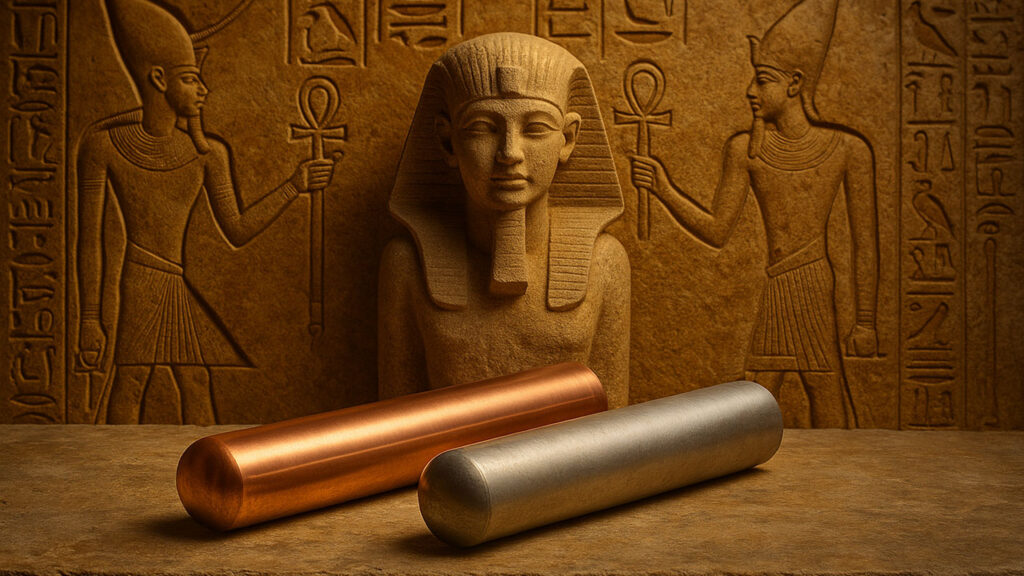
Modern reconstructions describe the rods as being made of copper (a conductor aligned with feminine, lunar, and receptive energy) and zinc (associated with masculine, solar, and active energy). When held in opposite hands, they create a subtle energetic current across the body.
Inside, they were filled with materials believed to resonate at specific frequencies:
- Quartz crystals – amplifiers of energy.
- Carbon or charcoal – grounding, absorbing, and purifying.
- Metallic powders – enhancing conductivity.
- Special mineral mixtures – designed to match cosmic alignments.
Shape and Resonance
The rods were usually smooth, cylindrical, and approximately the size of a modern flashlight handle. Their simplicity concealed a profound design: they were tuned to work with the body’s meridians and chakras, creating resonance between the user and cosmic fields.
Esoteric and Healing Functions
Energy Balancing
Pharaoh Rods are said to balance the bio-energetic field (sometimes called the aura). By holding them in both hands—zinc in the right, copper in the left—the body’s natural polarity is harmonized. This balance supposedly aids meditation, psychic perception, and healing processes.
Spiritual Elevation
Initiates reportedly used the rods during temple rituals to reach altered states of consciousness. By amplifying subtle currents, the rods facilitated astral travel, dream lucidity, and mystical insight. They were seen as tools for preparing the soul for union with the divine.
Healing Practices
In metaphysical healing traditions, the rods were applied to:
- Stimulate circulation and energy flow
- Reduce fatigue by recharging the nervous system
- Alleviate stress and tension through electromagnetic balancing
- Support meditation by calming mental chatter
Symbolic Connections in Ancient Egypt
The Djed and Was Scepters
Egyptian iconography frequently shows the Djed pillar (symbol of stability) and the Was scepter (symbol of power). Some researchers suggest that the Pharaoh Rods functioned as practical embodiments of these symbols: channels of stability, power, and divine authority.
Alignment with Temples and Stars
The Egyptians were masters of alignment—temples were oriented to stars, solstices, and cosmic harmonics. The Pharaoh Rods may have served as personal alignment tools, helping initiates tune their own energy fields to match the greater cosmic order.
Rediscovery in Modern Times
Early Esoteric Accounts
In the 19th and 20th centuries, occult researchers studying Egypt began speculating about hidden technologies. Russian researchers in the 20th century, including the work of Valery Uvarov, helped bring the idea of Pharaoh Rods into modern metaphysical circles. Uvarov and others constructed rods filled with quartz and minerals, claiming physiological and spiritual benefits.
New Age Adaptations
By the late 20th century, the Pharaoh Rods had become a staple in New Age healing, meditation, and esoteric workshops. They were marketed as “personal energy tools” capable of balancing chakras, enhancing vitality, and even accelerating spiritual awakening.
Scientific and Pseudoscientific Perspectives
Electromagnetic Theories
Some proponents argue that copper and zinc rods create a low-level galvanic current, subtly stimulating the nervous system. The addition of quartz or carbon may interact with electromagnetic fields, possibly influencing brainwave states.
Skeptical Views
Mainstream science remains unconvinced, viewing Pharaoh Rods as pseudoscience. Critics suggest that any perceived benefits are due to placebo, relaxation response, or the meditative focus they encourage. Nonetheless, the subjective experiences of users—ranging from increased vitality to visionary states—cannot be entirely dismissed.
Possible Bio-Resonance
A middle ground perspective proposes that while the rods may not have measurable physical effects, they could function as bio-feedback tools—focusing attention, calming the nervous system, and enhancing self-regulation.
Pharaoh Rods in Practice
Meditation Techniques
A common method involves sitting quietly, holding the copper rod in the left hand and zinc in the right. Breathing deeply, the practitioner visualizes energy flowing between the hands and through the heart. After 10–20 minutes, many report feelings of peace, tingling sensations, or heightened awareness.
Ritual and Ceremony
Some modern esoteric groups integrate the rods into ceremonies involving chanting, drumming, or crystal grids. They are used to amplify intention, anchor energy fields, and connect with solar archetypes.
Healing Sessions
Energy healers may place rods on a client’s chakras, or have the client hold them during a Reiki or sound-healing session. The rods are said to accelerate the harmonization process, working as amplifiers of subtle energy.
Comparative Parallels in World Traditions
Indian Yogic Practices
In yoga, the balance of ida and pingala (the lunar and solar nadis) is central. Pharaoh Rods mirror this by balancing left/right polarities.
Chinese Qigong
Chinese tradition speaks of balancing yin and yang energies through breath and movement. The rods may have functioned as passive qigong tools, harmonizing chi without physical exercise.
Atlantean and Lemurian Connections
Some esoteric traditions link the rods back to Atlantis or Lemuria, suggesting the Egyptians inherited these tools from earlier civilizations. This perspective ties into broader theories of ancient advanced technologies lost to time.
Testimonies and Experiences
Reports from Practitioners
- Physical sensations: tingling, warmth, or subtle pulsing in the hands.
- Emotional release: calming of anxiety, a sense of balance.
- Spiritual insight: vivid dreams, intuitive downloads, or mystical visions.
Case Examples
In workshops led by metaphysical teachers, participants often describe the rods as catalysts for entering deep meditation faster than usual. Some report spontaneous kundalini awakenings, while others experience simple relaxation.
The Rods and Sound Resonance
Interestingly, Pharaoh Rods are sometimes paired with sound healing. Quartz crystals within the rods resonate with specific frequencies, making them effective companions to gongs, crystal bowls, or chanting. This combination may echo the sound healing temples of Saqqara, where resonance and geometry were employed for transformation.
Legacy and Influence
Modern Spiritual Culture
Pharaoh Rods symbolize the blending of archaeology, myth, and spiritual technology. They reflect a longing to reconnect with ancient wisdom, where spirituality and science were not divided.
Inspiring Future Research
Even if scientific validation remains elusive, the rods inspire inquiry into subtle energy, biofield science, and consciousness studies. They challenge modern thinkers to reconsider the mysteries of human potential and ancient knowledge.
The Pharaoh Rods (Rods of Ra) embody a powerful mythos: tools of balance, healing, and spiritual ascension. Whether seen as symbolic artifacts, subtle energy devices, or imaginative reconstructions, they invite us into a dialogue between past and present, matter and spirit, science and mystery.
In the end, perhaps the greatest value of the Pharaoh Rods lies not in their physical composition but in the state of consciousness they inspire. They remind us that the ancient Egyptians were not only masters of stone and astronomy but also seekers of the inner light—the same light we continue to pursue today.