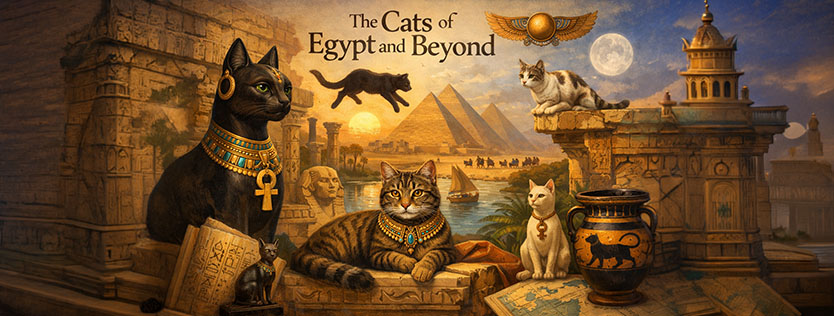
The Cats of Egypt and Beyond
We have unique relationships with animals, especially with our pets. Dogs have been trained, bred, and influenced by us throughout history. They have helped us hunt, protected us, and have become reliant on their “owners”. Horses have carried our loads, pulled our vehicles and worked in unison with those that they carry on their backs. Cats on the other hand have chosen to live with us and while they form bonds, they make it understood that they grace our lives—not the other way around.
Today’s domestic cat’s lineage is genetically traced back to Ancient Egypt. In the wild, cats are independent. They claim territories and battle to protect them. They have little interest in people, that is until contact works to their advantage. When the fertile Nile Valley of Ancient Egypt attracted permanent settlements, large stores of grain attracted rodents and snakes. (Yes, even the King Cobra.) Cats soon saw an opportunity. They came closer and eventually settled in, taking full advantage of easy prey and companionship with other cats and with people. Women especially took a liking to having them around and they are often pictured perched beneath a woman’s chair—bringing fertility and easy birthing. Egyptian women related to the nurturing and protection that the females showed their young—often fiercely defending their families. It is this fierceness and willingness to do battle that spurred much of Egyptian mythology surrounding the two most idolized Cat Goddesses—Bastet and Sekhmet.
The mythology behind these two prevalent cat goddesses is symbolic of the human condition, not only in Egypt but in the minds and hearts of humanity. Bastet and Sekhmet are especially revered by women due to their relentless protection of home and family as well as their ability to do ferocious battle against evil forces.
During my research I found several versions of their story, dependent upon who’s telling it. As Joseph Campbell, in his famous work, “The Power of Myth”, said, “Myth is the song of the universe, the music of the spheres.” In the case of our cat sisters. Sometimes they’re dressed in military gear and sometimes they are in beautiful flowing gowns that embrace their many charms. The message is an attitude of—we can get along fine, just don’t mess with me or my family. Meow! (By the way, many Egyptian cats were called miw or mau pronounced “mee-oo”, mimicking the sound a cat makes. These terms often appeared in hieroglyphs as directly translating to “cat” or “one who meows”.)
In some accounts Bastet and Sekhmet are sisters—daughter of Ra, the sun god. While Bastet is most often described as a nurturing protector of hearth and home. Sekhmet embodies the many aspects of humankind, specifically women, in that once triggered they are not easily contained. There is a confusion about whether Sekhmet and Hathor are in fact the same goddess with a split personality. In today’s words, we may even call her bi-polar or schizophrenic!
Apparently, at some point the sisters’ father Ra became perturbed about how humans were treating him and he felt conspired against. In his narcissistic rage he sent his daughter Hathor/Sekhmet down to earth to punish humanity and the fierce lioness personality emerged. Usually, this facet of the goddess is represented as Sekhmet, dressed in fighting gear and armed to the hilt. However, she got carried away with her mission, killing everyone she met and drinking their blood. Ra had second thoughts about this, realizing he would no longer have anyone to rule, so he tricked Sekhmet by flooding the fields with red dyed beer, that resembled blood. When Sekhmet saw the yummy feast; she drank the red concoction until she passed out. When she woke, she transformed once again into a more benevolent goddess—yet she never again became as gentle as her previous incarnation as Hathor.
Our second goddess, Bastet, (also called Bast) unlike her sister, is mostly seen as divine feminine energy. Bastet was central to the spiritual elevation of cats in Egyptian culture. Originally depicted as a lioness, she later evolved into the form of a domestic cat, representing a gentler aspect of divine protection, motherhood, and harmony.
Bastet was associated with:
- Protection of the home
- Fertility and childbirth
- Joy, music, and sensual pleasure
- Healing and good health
Her feline symbolism reflected both fierce protective power and nurturing feminine energy. Egyptians believed Bastet could take the physical form of a cat to guard households and defend against illness or malevolent forces. Thus, when an Egyptian cared for a cat, they were, in a sense, honoring the presence of the goddess herself.
High up in the Nile delta there’s a city, Bubastis, considered a feminine stronghold, that is even mentioned in the Bible as a site where Jesus, Mary, and Joseph lived for a time after they fled into Egypt. Bubastis reached its peak during the 22nd Dynasty (c. 945–715 BCE) where it served as the capital of Egypt. The red granite temple of Bastet is described at that time as the most beautiful in Egypt. There is conflicting information about who originally built this site, and it was improved upon throughout more than a few dynasties. However, the city was occupied mostly by women, and they adopted Bastet as their local goddess. She appeared in many forms, as a nurturing house cat and as a terrifying avenger of justice. She often played a rattling instrument called a sistrum, which coincidently was also a favorite of Hathor/Sekhmet—showing once again the duality of their relationship. Once a year during the festival of Bubastis, people partied hardy, drinking as much wine as they could manage, and women enjoyed relative equality with men. It is not surprising that when the Temple was excavated starting in 1887 that over 300,000 mummified cats were uncovered. And to this day, Egyptian cat artifacts from this region fill museum halls throughout the world.
Today, cats have expanded their reach, becoming only second to dogs as the world’s favorite pet. Many continue to revere cats as earthly representatives of the divine and as bridges between worlds and dimensions. I’ll have to admit, that I do see something otherworldly in my cats’ eyes as they stare with pupils flashing, when I see nothing. They continue to be fearless hunters and have a protective sense—often comforting us with their purrs when we feel physical or mental disorder. They may have originated in the Middle East, but they have traveled with humankind to every distant point of the earth, appearing along the Silk Road to Asia and India, on ships to North and South America, and kept as loving pets in Europe and beyond. The only continent they don’t appear is Antarctica, and they would probably follow us there, if provided with warmth and sustenance. If cats are nothing else, they are adaptable—calculating possibilities and knowing a good thing when they see it.
Today, social media loves cats. In fact, they have become one of the main animal influencers on the internet. As an equal opportunity animal lover, many types of videos cross my screen. However, especially, if I’m stressed, or feeling bad about the world, I’ll take a few minutes, to watch the kitten try to complete a leap from the windowsill to the couch and after landing elsewhere, righting itself with an “I meant to do that,” face. In some way I think we all relate to their “Be Here Now” attitude, —or how they can make a cardboard box into the most voluptuous place to nap—even when they barely fit. It is this tendency to adapt to any circumstance that inspires us to cope in an uncertain world. To seek warmth and shelter. To protect and defend our friends and families. To lick our wounds and overcome embarrassments. To relax in otherwise stressful situations. To hide from danger. To play with our friends. The list is endless.
Psychologists have taken note of how living with or even just watching cats influences our behavior. They see cats as highly intelligent, social, and sensitive companions that bond deeply with us. Just having cats around reduces stress. The Japanese in their high stress corporate structure have begun to adopt cats into their office environments to help employees. The cats roam the offices, boosting moods, and improving morale. The employees provide the felines’ care which also helps build personal bonds between workers. Some companies foster cats and kittens until they can find permanent homes. They build cat-friendly environments with cat-walks, scratch resistant walls, and multiple litter stations.
Cats have come a long way in over 12,000 years, since the first adventurous feline wandered into an Egyptian grain silo and they’re not going anywhere. Yet, adoption agencies continue to be inundated with the unwanted. Is there a cat companion in your future? Even if your lifestyle doesn’t include a household pet, visit a local shelter, even just to soak up those deep purrs. Give a few dollars, or donate some time to feline friends. And if you already have cat companions, give them some extra pets, a kiss or two, and tell them that you remember them from ‘Mu the Motherland’.